

The Professor Chris Harrop OBE Book Collection
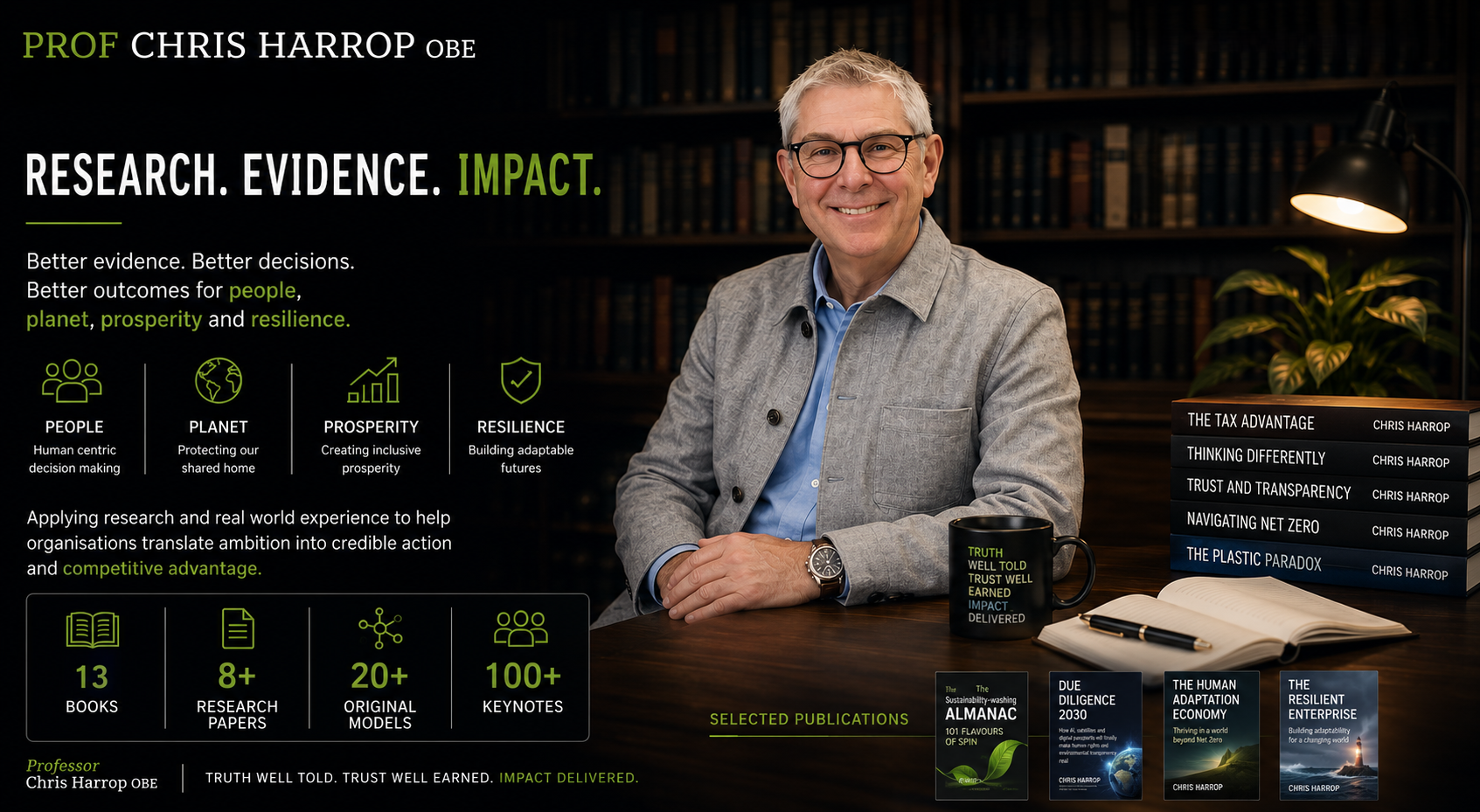
A connected collection of books exploring sustainability, trust, governance, human centricity, climate adaptation, national resilience and sustainable prosperity.

Sustainability-Washing
Why good intentions fail and language masks weak systems
Sustainability-Washing examines why so many corporate sustainability claims fail to translate into meaningful outcomes. The book argues that sustainability-washing is rarely driven by malice alone; more often it arises from misunderstanding, weak capability, poor governance and misaligned incentives.
Introducing the 4M model; Mistakes, Misunderstanding, Manipulation and Malice the book provides a proportional, diagnostic framework that allows leaders to distinguish between error and deception, and to respond appropriately. It shows how language, metrics and reporting can create false confidence, delay action and erode trust when not backed by operational reality.
Drawing on trust data, regulatory responses and real-world business practice, the book reframes sustainability-washing as a systems failure, not a communications one. Its central message is clear: better words cannot compensate for weak systems.
Download on Gumroad →
Chains Unseen: Confronting Modern Slavery in the UK
Making invisible harm visible
Chains Unseen exposes the reality of modern slavery within the UK economy, challenging the assumption that exploitation is distant, exceptional or accidental. Using UK-specific data, sector analysis and supply-chain evidence, the book shows that modern slavery is a predictable outcome of opaque systems and economic pressure.
The book critically examines the UK Modern Slavery Act, recognising its role in raising awareness while demonstrating its structural weaknesses: weak enforcement, performative reporting and limited coverage. It argues that voluntary disclosure alone is insufficient to prevent harm.
Importantly, Chains Unseen avoids moral sensationalism. Instead, it frames exploitation as a design failure, rooted in procurement practices, price pressure and risk displacement. Responsibility, the book argues, begins upstream with system design, incentives and governance.
Download on Gumroad →
Business as a Force for Good
From mitigation to regeneration
This book marks a decisive shift from critique to construction. Business as a Force for Good argues that sustainability defined as “doing less harm” is no longer sufficient in the face of climate breakdown, biodiversity loss and social fragmentation.
The book introduces regenerative business as a strategic and economic necessity, not a moral aspiration. It maps a progression from compliance to sustainability, net zero, net positive and regeneration, showing how businesses can actively restore environmental, social and human systems.
Rather than promoting a single model, the book presents multiple regenerative pathways, acknowledging complexity, trade-offs and sectoral differences. Human wellbeing, diversity of thought and organisational culture are positioned as central enablers of regeneration.
Download on Gumroad →
The Resilient Enterprise
Why sustainability underpins survival
The Resilient Enterprise reframes sustainability as a core survival capability in an era of permanent disruption. Drawing on climate risk, geopolitical instability, technological acceleration and declining trust, the book argues that there is no return to “normal”.
Resilience is defined not as recovery, but as adaptive capacity the ability to absorb shocks without breaking. Sustainability is presented as the operating system that enables resilience, through energy security, circularity, trusted relationships and human capacity.
The book elevates trust from reputation to infrastructure, showing how low-trust organisations fracture faster under stress. It also introduces a balanced view of AI as both accelerator and fragility multiplier.
Download on Gumroad →
Navigating the Net Zero Landscape
Restoring clarity, science and credibility
This book tackles confusion surrounding Net Zero, arguing that poor definitions, politicisation and over-reliance on offsets have undermined trust and delayed action.
Re-anchoring the debate in climate science, the book explains carbon budgets, cumulative emissions and the limits of offsets. Net Zero is framed as a process, not a promise, requiring deep emissions reductions before any balancing occurs.
The Science Based Targets initiative (SBTi) is positioned as the best current defence against Net Zero-washing, while acknowledging its limitations. The book repeatedly stresses that capability must precede credibility.
Download on Gumroad →
Thinking Differently
Why diversity of thought is the only enduring advantage
Thinking Differently argues that in a world of complexity and AI-driven commoditisation, people are the only sustainable source of competitive advantage.
Focusing on neurodiversity and diversity of thinking, the book reframes inclusion as organisational intelligence rather than social compliance. It shows how cognitive homogeneity creates efficiency but fragility, while cognitive diversity enhances adaptability, innovation and resilience.
Rather than romanticising neurodiversity, the book emphasises system design, reasonable adjustments and leadership capability. AI is treated as an amplifier of human judgement, not a replacement for it.
Download on Gumroad →
Trust and Transparency
The foundations of a social licence to operate
This book presents a governing theory of business legitimacy in the 21st century. It argues that legal compliance is no longer sufficient; businesses must continually earn their social licence to operate.
Introducing the R.E.A.L. framework (Relevance, Equity, Accountability, Legitimacy), the book positions trust as economic infrastructure and transparency as strategic strength. CEOs are reframed as Chief Trust Officers.
Trust is shown to drive resilience, loyalty and long-term value, while opacity accelerates fragility. Expectations, not regulation, become the new risk landscape.
Download on Gumroad →
Sustainability Cleansing
Why responsible business has gone quieter
This book examines the paradox of sustainability retreating from language while advancing in practice. It introduces sustainability cleansing, the deliberate reduction or re-framing of sustainability language in response to political polarisation, fear and fatigue.
Distinguishing cleansing from greenwashing and green-hushing, the book shows how sustainability has moved from campaign to competence. However, it warns that silence must not erode accountability.
Language becomes a strategic risk, making evidence and proof more important than ever. This book explains the cultural and political context shaping modern corporate behaviour.
Download on Gumroad →
The Tax Advantage
Where trust becomes measurable
The Tax Advantage argues that responsible tax behaviour is the clearest and most objective signal of corporate integrity available.
Introducing Tax Funded Impact, the book reframes tax from cost to contribution, linking tax paid to public value creation. It shows how tax transparency underpins trust, legitimacy and social licence.
The book positions tax as the ultimate ESG proof point, resistant to rebranding and rhetoric. Accreditation such as the Fair Tax Mark is presented as trust infrastructure.
Download on Gumroad →
Making It Happen
Why sustainability fails and how to fix it
This book applies implementation science to sustainability, arguing that most failures stem from weak delivery systems rather than lack of ambition.
Using frameworks such as CFIR and RE-AIM, the book shows how strategies are adopted, embedded and sustained in real organisations. Trust, feedback loops and learning systems emerge as critical enablers.
Sustainability becomes a delivery discipline, not a narrative exercise. This book provides the execution logic underpinning the entire canon.
Download on Gumroad →
The Plastic Paradox
When sustainability becomes biological
The Plastic Paradox reframes plastic pollution as a biological and public-health issue, not merely an environmental one. With microplastics now found in human bodies, delay is no longer neutral.
The book dismantles the recycling myth, showing how it has delayed systemic redesign. It argues for prevention, material reduction and disciplined innovation over cleanup alone.
Download on Gumroad →
The Constraint Advantage
How better businesses thrive in an age of limits
This book integrates the 2025 books into a theory of competitive advantage. It argues that we have entered an age defined by physical, social, political and organisational constraints.
Rather than destroying advantage, constraints reallocate it. Businesses that align with limits, invest in people, implement with discipline and earn trust through evidence increasingly outperform those that resist reality.
Download on Gumroad →
Due Diligence 2030
How AI, satellites and digital product passports will transform human rights and environmental transparency.
Explores the transition from voluntary ESG reporting to mandatory human rights and environmental due diligence. It demonstrates how AI, satellite monitoring, digital product passports and improved data quality will transform corporate accountability, enabling organisations to turn compliance into trust, resilience and sustainable competitive advantage.
Download on Gumroad →
The Human Adaptation Economy
Creating the products and services that help society thrive in a 1.5°C world
Argues that while mitigation remains essential, adaptation will become one of the defining economic opportunities of the coming decades. It explores how organisations can develop products and services that protect people, communities and economies from the physical and mental impacts of climate change.
Download on Gumroad →
The Sustainability-Washing Almanac
101 flavours of misleading sustainability claims
An authoritative reference guide cataloguing 101 forms of sustainability-washing. It provides clear definitions, practical examples and diagnostic tools to help organisations distinguish genuine progress from misleading claims, strengthening trust, transparency and evidence-based communication.
Download on Gumroad →
The Net Zero Playbook
A practical guide to building Carbon Intelligence
Provides a practical implementation framework for organisations beginning or accelerating their Net Zero journey. Built around the Carbon Intelligence Framework, it translates climate science and standards into practical actions that improve carbon data quality, decision-making and competitive advantage.