
Human Adaptation Economy ©
Creating the products, services and innovations that help people thrive in a changing climate.
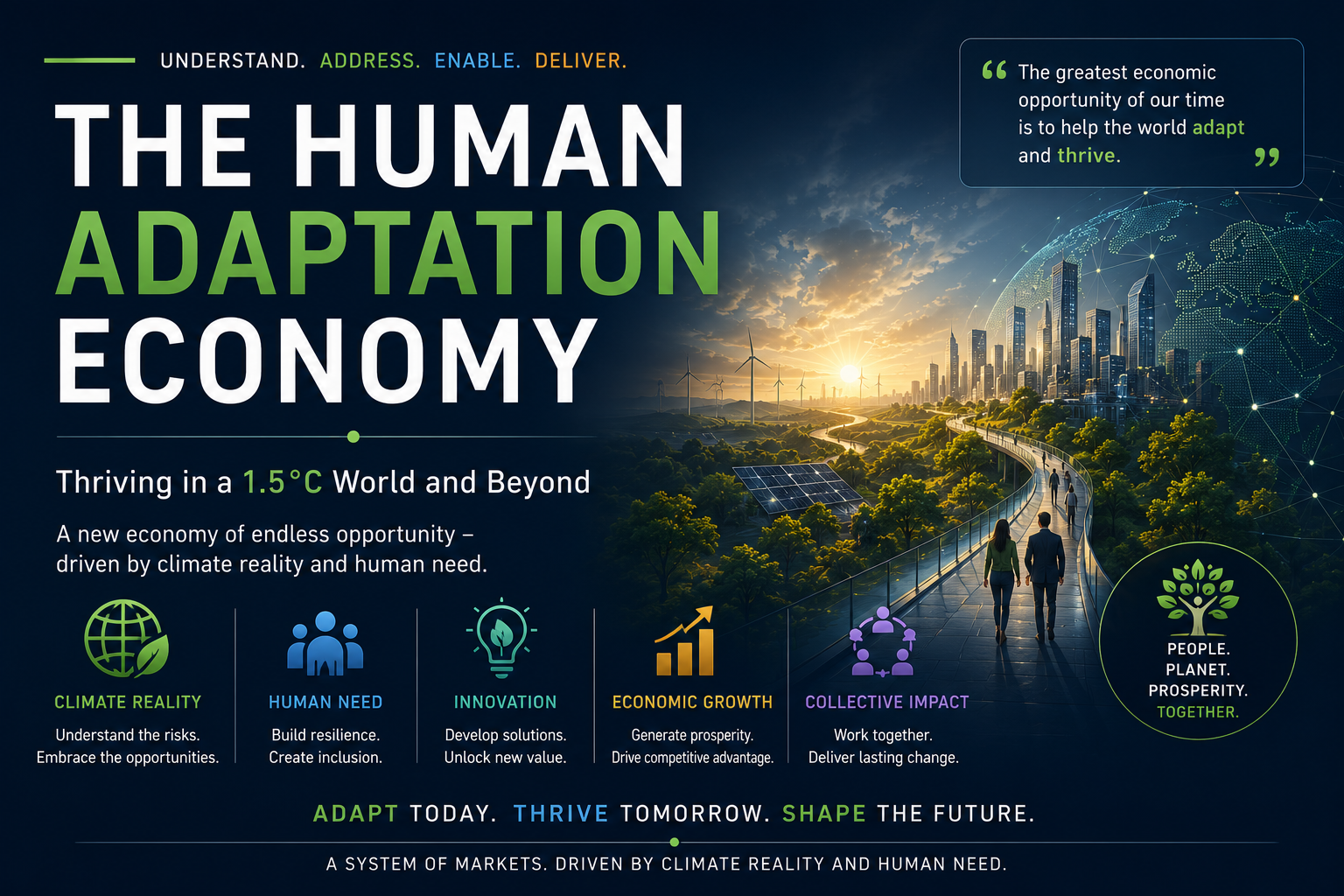
Creating Value in a Climate-Affected World
“Net Zero asks people to invest in avoiding tomorrow’s climate change. The Human Adaptation Economy helps them solve the climate impacts they are experiencing today.”
The Human Adaptation Economy © is an economic framework that explores one of the defining business opportunities of the twenty-first century: creating the products, services and innovations that help people thrive in a changing climate.
For more than three decades, climate policy has rightly focused on reducing greenhouse gas emissions. Mitigation remains essential.
However, the reality is that many of the impacts of climate change are now unavoidable.
Communities are already experiencing more frequent heatwaves, flooding, drought, severe storms, declining biodiversity, food insecurity and increasing pressures on both physical and mental health.
The Human Adaptation Economy © recognises that alongside reducing emissions, society must also invest in helping people adapt.
It argues that adaptation is not simply an environmental necessity.
It is the next great wave of innovation, investment and sustainable competitive advantage.

Six Interconnected Areas of Opportunity
The Human Adaptation Economy © places people at the centre of climate adaptation.
Rather than beginning with infrastructure or technology, the model begins with a simple question:
How can innovation help people live healthier, safer and more prosperous lives in a changing climate?
The model identifies six interconnected areas of opportunity.
Physical Health
Rising temperatures, changing disease patterns and more frequent extreme weather events are creating new public health challenges.
Innovation will increasingly focus on cooling technologies, resilient housing, nutrition, healthcare, wearable technologies and climate-resilient medical services.
Mental Health
Climate anxiety, ecological grief, displacement and uncertainty are becoming significant societal challenges.
Supporting psychological resilience through community programmes, digital services, education and healthcare will become an increasingly important part of adaptation.
Built Environment
Homes, workplaces, schools and public infrastructure must become more resilient to heat, flooding, water scarcity and severe weather.
This creates opportunities for innovation in construction, materials, urban design and resilient infrastructure.
Nature and Regeneration
Healthy ecosystems provide natural protection against many climate impacts.
Regenerative agriculture, biodiversity restoration, water management and nature-based solutions improve resilience while strengthening environmental recovery.
Adaptation and regeneration therefore become mutually reinforcing.
Technology and Artificial Intelligence
Artificial intelligence, digital twins, satellite monitoring, predictive analytics and sensor technologies will transform how societies anticipate and respond to climate risks.
Technology becomes an enabler of faster, smarter and more personalised adaptation.
Economic Resilience
Climate adaptation represents one of the largest emerging markets of the coming decades.
Businesses that anticipate these changing needs will develop new products, services and business models that improve resilience while generating sustainable economic growth.
Adaptation therefore becomes both a societal necessity and a commercial opportunity.
From Mitigation Alone to Adaptation and Regeneration
Much of today’s climate debate remains centred on emissions reduction.
While essential, mitigation alone cannot address the impacts that people are already experiencing.
The Human Adaptation Economy © broadens the conversation.
It encourages governments, businesses, investors and innovators to view adaptation not as a cost of climate change but as a catalyst for economic transformation.
Just as the Industrial Revolution created entirely new industries, the transition towards climate adaptation will stimulate unprecedented innovation across healthcare, housing, finance, food systems, insurance, digital technology, education and public services.
The organisations that recognise this opportunity early are likely to become the market leaders of tomorrow.
Where the Model Can Be Applied
The Human Adaptation Economy © supports:
Its principles are relevant to governments, businesses, investors, universities and entrepreneurs seeking to create solutions for an increasingly climate-affected world.
Climate adaptation is not simply about protecting society from climate change. It is about creating the products, services and innovations that enable people to thrive despite it.
The Future-Facing Expression of Sustainable Competitive Advantage
Within The Harrop Framework ©, the Human Adaptation Economy © represents the future-facing expression of sustainable competitive advantage.
The Human Centricity Model explains why organisations exist to improve people’s lives.
The Carbon Intelligence Cycle © provides the evidence needed to reduce environmental impacts.
The Tax Funded Impact Model demonstrates how governments can stimulate innovation through fiscal incentives.
The National Cohesion Systems Model highlights the importance of resilient communities capable of adapting together.
Together these models demonstrate that the organisations most likely to succeed in the coming decades will be those that combine mitigation with adaptation, innovation with evidence, and commercial success with positive societal impact.
Connected Thinking Across the Framework
The Human Adaptation Economy © is closely connected to:
The Harrop Framework ©
Positioning adaptation as a source of sustainable competitive advantage.
Human Centricity Model
Ensuring adaptation begins with people and their wellbeing.
Carbon Intelligence Cycle ©
Reducing emissions while providing evidence that informs adaptation decisions.
Tax Funded Impact Model
Encouraging investment in adaptation technologies and climate resilience solutions.
National Cohesion Systems Model
Strengthening societal resilience and collective adaptation in a changing climate.
Why I Developed This Model
Throughout much of my career, I have worked on helping organisations reduce their environmental impact.
That work remains critically important.
However, I have become increasingly convinced that the next chapter of sustainability will not be defined solely by carbon reduction.
It will be defined by our ability to help people adapt.
Every heatwave, flood, drought and severe storm creates new human needs.
Every new need creates an opportunity for innovation.
Every innovation creates the possibility of improving lives while building stronger, more resilient businesses.
The Human Adaptation Economy © is therefore not a departure from sustainability.
It is its natural evolution.
It recognises that protecting the planet and helping people adapt are not competing priorities.
They are complementary responsibilities.
For years, sustainability has often been framed around reducing harm.
The Human Adaptation Economy © reframes it around creating value.
Instead of asking:
“How do we reduce our environmental footprint?”
We should now be asking:
“What products, services and innovations can we create that help people live better lives in a world that is already changing?”