

The Prosperity Dependency Model
Business Prosperity Depends Upon Shared Prosperity
Business Prosperity Depends Upon Shared Prosperity
The Prosperity Dependency Model explores a simple but often overlooked business reality: businesses cannot prosper indefinitely in societies that are not themselves prospering.
Extreme concentrations of income and wealth are usually discussed through the lenses of politics, taxation or social justice. The Prosperity Dependency Model takes a different approach. It asks what businesses themselves need from society in order to succeed.
Businesses need customers with sufficient disposable income to buy their products and services. They need healthy, educated and skilled people. They depend upon functioning healthcare, education, infrastructure and institutions. They need communities in which people can participate, and sufficient trust, legitimacy and social cohesion to support stable markets and long-term investment.
The model identifies six interdependent foundations of business prosperity:
Customers
People need sufficient economic security and disposable income to participate in the economy and create sustainable demand.
People
Businesses need healthy, educated, skilled and capable people able to contribute their full potential.
Public Realm
Successful businesses depend upon functioning healthcare, education, infrastructure, institutions, public services and the rule of law. Together these form what I describe as the Business Commons.
Participation
Employment alone does not guarantee economic security. People need sufficient income, time, opportunity and confidence to participate meaningfully as employees, consumers, learners, entrepreneurs and members of their communities.
Cohesion
Trust, belonging, legitimacy and social stability matter to business. When people believe economic systems are fundamentally unfair, grievance can increase and trust in institutions and business can decline.
Prosperity
Economic value needs to circulate sufficiently through wages, consumption, investment, taxation, public services and communities to reproduce the conditions upon which future prosperity depends.
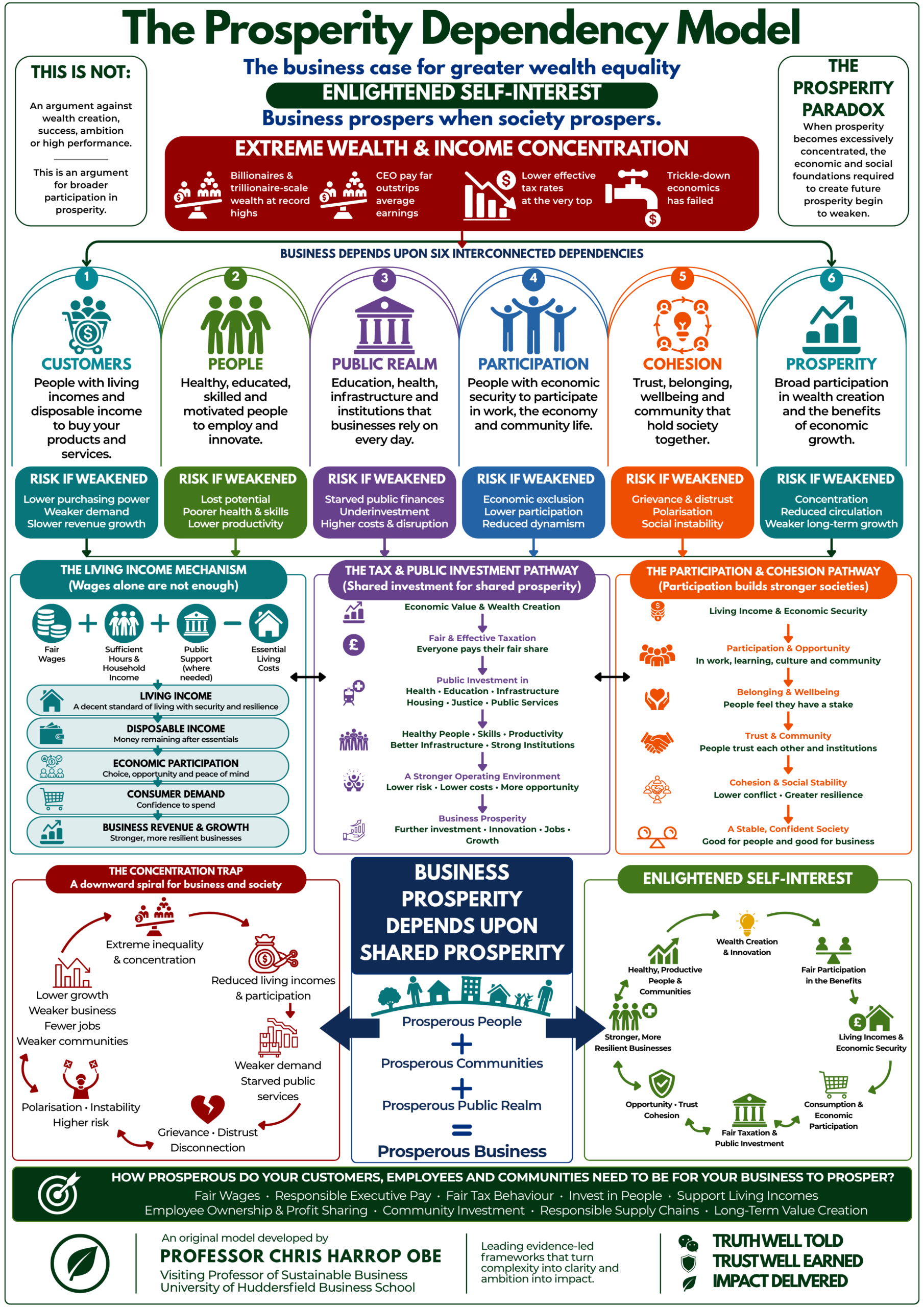
From Living Wage to Living Income
The model also distinguishes between a Living Wage and a Living Income.
A fair hourly wage is important, but it does not necessarily tell us whether a household has sufficient resources to live securely. Hours worked, housing, childcare, energy, transport, taxation, benefits and household circumstances all influence the final outcome.
This leads to one of the central propositions of the model:
Business does not simply need people who can afford to live. It needs people who can afford to participate.
Where people are technically included in the economy but lack the resources, security, time or opportunity to participate fully, I describe this as the Participation Deficit.
The Social Dividend of Shared Prosperity
Greater participation can create benefits beyond additional consumer spending.
Economic security can enable participation. Participation can strengthen relationships and agency. These can support belonging, wellbeing and trust, which in turn can contribute to greater social cohesion and stability.
I describe this potential wider benefit as the Social Dividend of Shared Prosperity.
The relationship is not automatic, and economic inequality is not the sole cause of social division. But businesses have a legitimate interest in understanding the economic conditions that help create healthy, participative and cohesive societies.
From Trickle-Down to Prosperity Circulation
The model challenges the simplistic assumption that prosperity created at the top will inevitably “trickle down” through an economy.
Instead, it proposes Prosperity Circulation.
Prosperity moves continuously between businesses, employees, consumers, investors, suppliers, government, public services and communities.
Businesses create employment and wages. Households consume and save. Consumption becomes business revenue. Savings can become investment. Businesses and individuals pay taxes. Taxation supports education, healthcare, infrastructure and institutions. These help create the people, markets and conditions businesses require to create the next generation of prosperity.
Wealth creation is essential. Wealth circulation helps sustain the system that creates it.
The Prosperity Paradox
This creates what I call the Prosperity Paradox:
When prosperity becomes excessively concentrated, the economic and social foundations required to create future prosperity may begin to weaken.
An economy can become wealthier in aggregate while purchasing power, opportunity, public infrastructure, participation or trust weaken for significant parts of society.
Individually rational decisions can therefore collectively produce a weaker system. I describe this as the Concentration Trap: the difference between optimising an individual organisation or outcome and optimising the economic ecosystem upon which everyone ultimately depends.
Enlightened Self-Interest
The Prosperity Dependency Model is not an argument against wealth creation, entrepreneurship, investment or appropriate reward.
Nor does it advocate equality of outcome.
It argues for broad participation in prosperity.
For business leaders, supporting fair wages and Living Income, investing in skills, sharing productivity gains appropriately, paying fair tax, treating suppliers responsibly, supporting the Business Commons and considering the legitimacy of executive reward need not simply be acts of corporate responsibility.
They can represent Enlightened Self-Interest.
A healthy economy needs prosperous businesses.
But prosperous businesses also need healthy economies.
The Prosperity Dependency Test
The model can be translated into six practical questions for boards and leadership teams:
Customers
Do enough people possess the financial capacity to buy what we sell?
People
Will society continue to produce the healthy, educated and skilled people our business requires?
Public Realm
Are the infrastructure and institutions upon which we depend sufficiently funded and effective?
Participation
Can employees, customers and communities participate meaningfully in the economy?
Cohesion
Does sufficient trust, legitimacy and stability exist for our business to operate effectively?
Prosperity
Does economic value circulate sufficiently to reproduce these conditions?
These questions can be complemented by a Shared Prosperity Stress Test, asking what would happen to the business if household discretionary income fell, skills shortages increased, public infrastructure deteriorated, employee financial insecurity rose, consumer confidence weakened or social trust declined.
The model therefore reframes inequality from being somebody else’s social problem into a potential strategic business dependency.
Would Our Business Be Stronger If Prosperity Were More Broadly Shared?
Would our business be stronger if prosperity were more broadly shared?
If the answer is yes, then greater shared prosperity is not simply philanthropy.
It is not anti-business.
It is not anti-wealth.
It is strategy.
It is Enlightened Self-Interest.
Connected Thinking Across the Framework
The Prosperity Dependency Model was developed by Professor Chris Harrop OBE as part of his wider work exploring the relationships between people, trust, social cohesion, sustainability, resilience, prosperity and sustainable competitive advantage.
The model forms part of the wider Harrop Framework, reflecting the principle that long-term business success ultimately depends upon creating outcomes that are good for People, Planet and Prosperity.
The Harrop Framework
Connecting people, planet, prosperity and resilience through better decision-making.
Human Centricity Model
Recognising people as central to sustainable business and economic outcomes.
National Cohesion Systems Model
Exploring the relationships between inequality, trust, participation and social cohesion.
Tax Funded Impact Model
Exploring how responsible taxation can contribute to wider societal and economic value.
Sustainable Prosperity Cycle
Exploring how wealth can be converted into opportunity, human potential and sustainable prosperity.
Belief Conditioned Change Model
Understanding how perceptions of fairness can influence trust, belief and behaviour.
Truth Well Told → Trust Well Earned → Impact Delivered
Professor Chris Harrop OBE